What I Found Driving Through New Orleans’ Soul – You Gotta See This
Driving into New Orleans feels like slipping into a dream where music spills onto the streets and every corner hums with history. I hit the road not for the guidebook spots, but to uncover the city’s themed neighborhoods—the real magic lies in how each area tells its own story. From the French Quarter’s vibrant chaos to the quiet charm of Garden District, self-driving gave me freedom to wander, pause, and connect. This is travel that breathes. The ability to move at my own pace, to detour on a whisper of jazz or a whiff of fried dough, transformed a simple visit into a personal journey through culture, architecture, and soul. New Orleans isn’t a city you see—it’s one you feel, and driving through it deepened every sensation.
The Freedom of the Open Road: Why Self-Driving Changes Everything
Choosing to explore New Orleans by car was not just a logistical decision—it was a philosophical shift in how I experienced the city. Most visitors rely on walking, guided tours, or ride-shares, which often lock them into predictable routes and rigid schedules. But renting a car offered something rare: autonomy. Suddenly, I wasn’t confined to the French Quarter after dark or dependent on unreliable public transit. I could leave the bustling center, return at will, and discover corners of the city that thrive beyond the tourist spotlight. This kind of freedom reshapes travel from observation into immersion.
The practical advantages were immediate. I could start my mornings early, beating the humidity and the crowds, and end my nights late, chasing live music in neighborhoods where sidewalks grow quiet after 10 p.m. Public transportation in New Orleans, while historic and charming in parts, doesn’t reach every district with ease. The streetcar lines are limited, and buses can be infrequent. With a car, I could park near a cultural landmark, then walk through surrounding blocks without worrying about how to get back. This flexibility turned short visits into extended explorations, allowing me to return to favorite spots at different times of day and see how they transformed in sunlight, twilight, and moonlight.
Of course, driving in a historic city comes with its own rhythm. One-way streets weave through the French Quarter like veins, and parking requires patience and planning. I quickly learned to use municipal garages or designated lots rather than circling for street spots. Fuel wasn’t a major concern—most destinations were within 20 minutes of each other—but I kept a full tank for spontaneous detours. Navigation apps helped, though GPS could lag in narrow lanes or under thick oak canopies. Still, the occasional wrong turn led to unexpected rewards: a corner store selling hand-labeled hot sauce, a brass band practicing in a schoolyard, a mural so vivid it stopped me in my tracks. The car wasn’t just transportation; it was a tool for serendipity.
French Quarter: Where Culture Never Sleeps
No visit to New Orleans feels complete without stepping into the French Quarter, the city’s beating heart and cultural nucleus. The moment I parked near Bourbon Street and stepped out, the air wrapped around me—warm, thick, and alive with the sound of trumpets, laughter, and clinking glasses. But I didn’t come just for the party. I came to witness the layers of life that unfold here around the clock. Walking is essential in the Quarter, yes—but driving back at different hours revealed dimensions I might have missed otherwise.
During the day, the Quarter hums with a different energy. Families stroll along Royal Street, browsing art galleries and antique shops. Musicians set up near Jackson Square, their cases open for tips. The scent of chicory coffee drifts from café doors, mingling with the sweetness of beignets frying at Café du Monde. I found that parking just outside the core and walking in allowed me to avoid the congestion while still being close enough to explore on foot. But returning by car in the early evening showed me something new: the shift from daylight calm to nighttime pulse. Lights flicker on above wrought-iron balconies, street performers take their positions, and the first notes of a jazz trio float into the warm air.
Driving through the Quarter at twilight—windows down, music low—let me absorb the atmosphere without being swallowed by it. I could circle around Conti Street and catch a second line parade turning the corner, or pause near a courtyard where a private wedding celebration spilled music into the street. These moments weren’t on any tour schedule. They were alive, unscripted, and fleeting. The car gave me the vantage of a quiet observer, letting me witness the Quarter not as a spectacle, but as a living neighborhood where celebration and daily life are inseparable. And when the noise grew too much, I could retreat—just a few minutes away—to quieter streets, recharge, and return when I was ready.
Garden District: Elegance on Every Porch
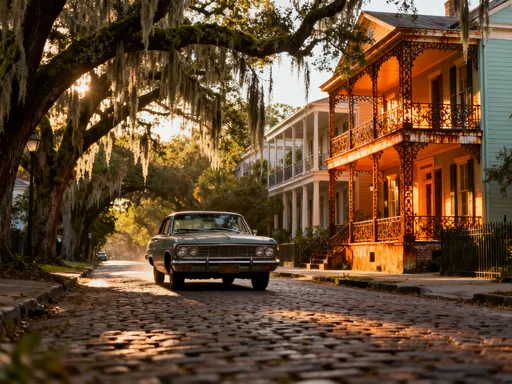
Just a short drive from the French Quarter’s frenzy lies the Garden District, a world apart in rhythm and design. As I turned onto St. Charles Avenue, the city seemed to exhale. Towering live oaks arched overhead, their branches draped in silver moss, forming a canopy that softened the sunlight. The homes here are not just houses—they are statements of history, craftsmanship, and Southern grace. Painted in soft pastels, adorned with ironwork and wraparound porches, they stand as monuments to a bygone era, yet remain very much part of modern New Orleans life.
Walking through the Garden District is lovely, but driving allowed me to appreciate the scale and continuity of its design. The neighborhood unfolds over several square miles, with blocks of meticulously preserved homes that tell a story of wealth, tradition, and resilience. On foot, it’s easy to miss the broader pattern—the way streets curve gently, how gardens flow from one property to the next, the quiet symmetry that defines the area. From the car, I could take in the full sweep of a block, notice architectural details repeated across facades, and spot side streets so tranquil they felt like secrets.
One of my most memorable stops was near Magazine Street, where I parked and wandered into a small section of Lafayette Cemetery No. 1. While cemeteries are a notable feature of New Orleans due to the city’s high water table, I approached with respect, focusing not on individual graves but on the artistry of the above-ground tombs and the peaceful atmosphere. The site offered a quiet contrast to the city’s energy, a place to reflect without lingering on themes of mortality. Back in the car, I continued along Prytania Street, where magnolias bloomed and dogs trotted beside their owners. The Garden District isn’t a museum—it’s a lived-in neighborhood, and driving through it let me observe its daily rhythm without intruding.
Treme: The Cradle of Creole Culture
Just across Rampart Street from the French Quarter, the Treme neighborhood stands as one of the oldest African American communities in the United States—a place where Creole culture, jazz music, and community resilience have flourished for generations. This is not a district designed for tourists, but one that welcomes respectful visitors who come to learn and listen. Driving through Treme gave me access to corners of the city where culture isn’t performed for an audience, but lived as a natural part of everyday life.
I arrived in the late afternoon, parking near St. Augustine Church, a historic landmark known for its role in the civil rights movement and its vibrant musical traditions. As I walked, I heard the faint sound of a trumpet from a backyard—likely a young musician practicing. A few blocks away, a small group of men gathered near a corner store, not loitering, but sharing stories and laughter in a rhythm that felt timeless. I didn’t intrude, but I listened. Later, I found a modest restaurant tucked between homes, its hand-painted sign advertising gumbo and fried chicken. There were no crowds, no online reviews—just a place where locals eat, and where I was welcomed with a nod and a warm plate.
Driving allowed me to approach Treme with care. I could observe from a distance when appropriate, park discreetly, and move on when the moment felt right. I learned that the best way to honor a neighborhood like this is not to consume it, but to witness it. I attended a small outdoor concert in Louis Armstrong Park, where a brass band played with a joy that made strangers dance together. The car made it easy to arrive early, find shade, and leave before the crowds swelled. In Treme, I didn’t just see culture—I felt its heartbeat, steady and strong, carried forward through music, food, and community.
Bywater & Marigny: Artsy, Raw, and Alive
East of the French Quarter, the neighborhoods of Bywater and Marigny pulse with a creative, unfiltered energy. These areas feel like the city’s artistic subconscious—colorful, spontaneous, and always evolving. As I drove down Royal Street into Marigny, I was greeted by murals that covered entire buildings: a giant rooster in neon feathers, a woman with a crown of magnolias, a tribute to Fats Domino painted in bold blues and golds. Every block seemed to offer a new visual surprise, a testament to the community’s love of self-expression.
Bywater, in particular, has become a haven for artists, musicians, and free spirits. I found myself stopping often—first for a coffee at a quirky café with mismatched chairs and poetry on the walls, then for a photo of a yard filled with repurposed art: bicycles turned into sculptures, tires painted like flowers, a bathtub garden overflowing with ferns. The car made these pauses effortless. I could park safely, take my time, and continue without rushing. At dusk, I returned to a small bar on Piety Street, where a local band played funk-infused jazz to a packed, dancing crowd. Getting there on foot after dark would have felt less safe; with my car nearby, I could enjoy the music late into the night and leave when I chose.
What struck me most about Bywater and Marigny was their authenticity. There are no souvenir shops or chain restaurants here—just independent creators, family-run eateries, and a deep sense of place. I met a painter setting up an easel on the sidewalk, who told me, “We don’t try to impress visitors. We just live how we live, and if you like it, you’re welcome.” That honesty is rare, and driving allowed me to experience it without disrupting it. These neighborhoods don’t need to be tamed for tourism—they thrive because they remain true to themselves.
City Park vs. Audubon Park: Green Escapes with Personality
In a city known for its music and food, the parks of New Orleans are quiet heroes—spacious, shaded sanctuaries that offer relief from the heat and the crowds. I visited both City Park and Audubon Park during my trip, and while both are beautiful, they each possess a distinct character that reflects the neighborhoods around them. Having a car made it easy to bring what I needed—picnic supplies, a blanket, even bicycles from a rental shop—and turn a simple visit into a full day of relaxation and discovery.
City Park, one of the largest urban parks in the country, feels expansive and diverse. I entered near the New Orleans Museum of Art, where a sculpture garden winds through live oaks and lagoons. Further in, I found the Sydney and Walda Besthoff Sculpture Garden, a peaceful trail where modern art blends seamlessly with nature. I rented bikes from a nearby shop and rode along tree-lined paths, passing a golf course, a botanical garden, and the historic Carousel Gardens. Families picnicked near Big Lake, where egrets waded in the shallows. The park’s size means you can easily find solitude, even on weekends. With my car, I brought a cooler with drinks and snacks, making the day feel like a true outing rather than a quick stop.
Audubon Park, located near the Garden District, has a more intimate, classic feel. The live oaks here are legendary—some over 600 years old, their branches stretching so wide they create entire shaded worlds. I walked (and later drove) along the scenic loop, where joggers, dog walkers, and students from nearby Tulane University strolled in the late afternoon. The park features a golf course, tennis courts, and a small zoo, but what I loved most was the sense of continuity—how the park flows into the surrounding neighborhood, with porches facing inward, as if the community embraces it. I brought a book and sat beneath a massive oak, listening to the rustle of leaves and distant laughter. Both parks reminded me that New Orleans isn’t all noise and celebration; it also knows how to rest, reflect, and grow.
Offbeat Routes: Finding the Unexpected
Some of my most cherished moments in New Orleans happened not at famous landmarks, but when I got slightly lost. One afternoon, my GPS failed as I drove along the riverfront near the Bywater. Instead of panicking, I let go of the plan. I followed a road I hadn’t noticed before, passing repurposed warehouses with street art murals, small docks where fishermen cast lines into the Mississippi, and clusters of bikes chained to fences. The industrial edge of the area contrasted beautifully with bursts of color—painted shipping containers turned into art studios, a community garden sprouting from reclaimed land.
Another day, I drove north toward Lake Pontchartrain, drawn by stories of the seawall and the famous end-of-the-line restaurant, Morning Call, now located in City Park. The lake itself was breathtaking—vast and shimmering, with a breeze that carried away the city’s heat. I parked along the seawall and walked the length of it, watching families fly kites, cyclists ride in formation, and couples sit on benches facing the water. There was a quiet joy here, different from the French Quarter’s exuberance but just as authentic. I stayed until sunset, then drove back slowly, stopping at a neighborhood grocery where a woman handed me a fresh mango with a smile.
These unplanned detours became the soul of my trip. I learned that New Orleans rewards curiosity. A wrong turn led me to a backyard cookout where a man offered me a plate of jambalaya “just because you look hungry.” I didn’t stay long, but the gesture stayed with me. Another time, I stumbled upon a second line parade in full swing—neighbors dancing down the street behind a brass band, umbrellas twirling, children laughing. I parked at a distance, watched, smiled, and drove on, carrying the rhythm with me. These weren’t on any itinerary, but they were real, human, and deeply moving.
More Than Miles—A Journey Through Identity
As I returned the rental car at the end of my trip, I realized something profound: I hadn’t just seen more of New Orleans—I had understood it more deeply. Self-driving allowed me to move beyond the postcard version of the city and into its living, breathing reality. Each neighborhood I visited—French Quarter, Garden District, Treme, Bywater, Marigny—was not just a place on a map, but a mood, a memory, a chapter in the city’s ongoing story. The car didn’t distance me from the experience; it deepened it, giving me the space and silence to absorb what I saw.
Travel is often sold as a checklist: see this, eat that, snap a photo. But in New Orleans, I discovered a different kind of journey—one measured not in miles, but in moments of connection. The freedom to stop, to return, to wander without pressure allowed me to listen—to the music, to the silence between notes, to the stories whispered in alleyways and front porches. I learned that a city’s soul isn’t found in its monuments alone, but in its rhythms, its textures, its everyday life.
Driving through New Orleans taught me to travel with intention and respect. It reminded me that the best experiences are often unplanned, that beauty hides in plain sight, and that understanding a place means moving through it at human speed. The road didn’t just take me from one neighborhood to the next—it carried me into the heart of what makes New Orleans unforgettable. And if you go, don’t just visit. Drive. Listen. Let the city speak to you, one turn at a time.